📞  — free, 24/7
— free, 24/7 — free, 24/7| Package | Price per Dose | Price | |
|---|---|---|---|
| 180 pills | €0.72 | €185.96 €130.17 | |
| 120 pills | €0.81 | €138.14 €96.70 | |
| 90 pills | €0.94 | €120.43 €84.30 | |
| 60 pills | €1.05 | €90.32 €63.22 | |
| 30 pills | €1.24 | €53.12 €37.18 | |
| 180 pills | €1.45 | €373.71 €261.60 Free shipping | |
| 120 pills | €1.55 | €265.67 €185.97 Free shipping | |
| 90 pills | €1.69 | €216.07 €151.25 | |
| 60 pills | €1.80 | €154.08 €107.86 | |
| 30 pills | €1.98 | €85.00 €59.50 |
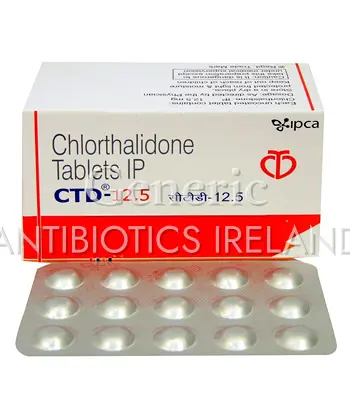
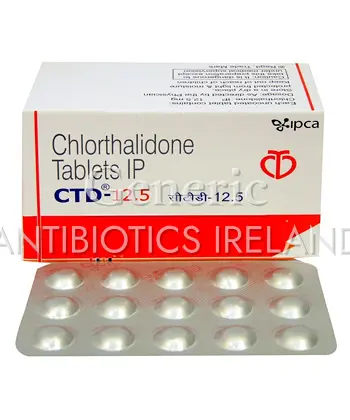
Chlorthalidone is a thiazide-like diuretic notable for a long elimination half-life of approximately 40–60 hours, permitting once-daily dosing and durable antihypertensive effect. Introduced in the 1960s, it remains widely used in the management of hypertension and cardiovascular risk reduction. The drug acts on the distal convoluted tubule, inhibiting the Na+-Cl− cotransporter and producing natriuresis with a comparatively mild diuretic response.
Its antihypertensive action is complemented by gradual vascular remodeling and reduced peripheral resistance with continued therapy. Pharmacokinetics show good oral bioavailability and extensive tissue distribution, with hepatic metabolism and renal excretion. The extended half-life supports steady-state control with minimal peak-trough variability. These characteristics underpin its role in long-term blood pressure management.
Common medical uses center on essential hypertension, where chlorthalidone lowers systolic and diastolic blood pressure and, in long-term trials, reduces cardiovascular morbidity and mortality. It is often chosen when additional edema control or synergistic BP reduction is needed. The diuretic effect also contributes to volume management in certain fluid-overload states.
Edema associated with congestive heart failure, cirrhosis, or nephrotic syndrome responds to diuresis with careful monitoring for fluid and electrolyte balance. The agent can also be used to manage idiopathic hypercalciuria and to lower urinary calcium excretion, contributing to stone risk reduction in select patients. The overall utility rests on balancing efficacy with electrolyte stability and hydration status.
Administration is typically oral, once daily in the morning to minimize nocturia. Absorption is efficient and reliable; administration with food has little effect on bioavailability, allowing flexible dosing schedules to suit patient preference. Dosing decisions consider age, renal function, and concomitant antihypertensive therapy.
In renal impairment, initiation at low doses with gradual titration is common, and concomitant diuretics or antihypertensives warrant careful monitoring for hypotension and electrolyte disturbances. In elderly patients, electrolyte and hydration status should be regularly assessed to prevent adverse events during therapy.
Important safety information includes regular monitoring of electrolytes—potassium, sodium, and magnesium—as well as uric acid. Hypokalemia, hyponatremia, and dehydration can occur, particularly when used with other diuretics or under heat stress. Blood pressure and kidney function should be tracked to adjust therapy as needed.
Contraindications include anuria and significant renal insufficiency. Use with caution in gout, diabetes, or pregnancy. Drug interactions include lithium and NSAIDs, which can alter volume status and renal perfusion, increasing adverse effects or diminishing diuretic efficacy.
Common side effects encompass dizziness, orthostatic hypotension, polyuria, thirst, and fatigue. Patients may experience mild cramps or electrolyte-related symptoms arising from potassium and magnesium shifts. Hydration status should be maintained, especially during hot weather or physical exertion.
Less frequent reactions include photosensitivity, hyperuricemia with gout flares, and mild hyperglycemia. Rare severe reactions involve significant electrolyte disturbances, severe dehydration, or hypersensitivity; patients should seek timely evaluation if new neurologic or cardiac symptoms occur.
14–21 days. Free from €178.66 .
5–9 days. €26.80
−10% when paying with cryptocurrency.
−10% on all repeat orders.
All orders are packed in neutral, unbranded boxes with no product name on the outside.